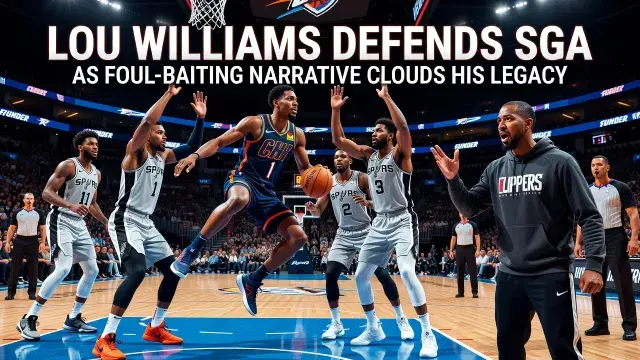
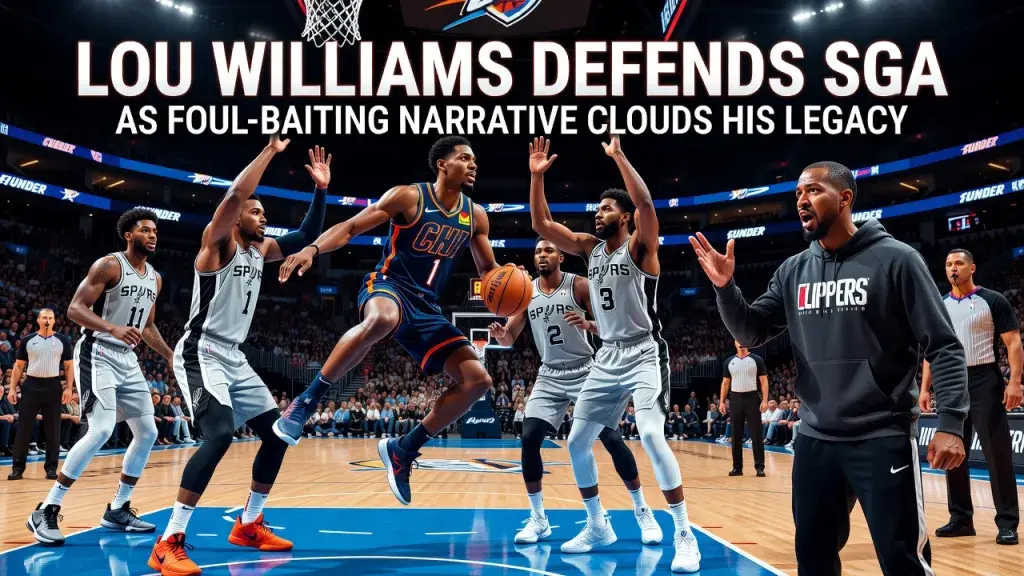
The San Antonio Spurs' disciplined defensive scheme in the 2026 Western Conference Finals did more than end Oklahoma City's postseason run - it reignited a conversation about Shai Gilgeous-Alexander that has been simmering all season. The 'Free Throw Merchant' label, once used half-jokingly by critics, has hardened into a legitimate talking point, and for the first time in his career, SGA's public standing appears genuinely fragile. Into that debate stepped Lou Williams, the former LA Clippers guard and one of the shrewdest offensive minds of his generation, offering the most personal defence of Gilgeous-Alexander heard yet.
Speaking on a recent episode of Underground Lounge, Williams drew on his time alongside a teenage SGA to counter the tide of criticism. "In our game, you want your young star to be coachable, a worker, one of the guys, the toughest, smartest," Williams said. "SGA was all of those things." Williams made clear his conviction ran deep from day one: "He was one of the first rookies that I was on the team with that I said, 'Hey, that boy going to be a star.'" It is the kind of first-hand testimony that carries weight - Williams was not a peripheral figure in that Clippers locker room, he was its most experienced offensive craftsman, a player who understood, better than most, how to manipulate contact and draw fouls himself. The irony of that context is not lost on those who have watched SGA's craft evolve. Much like how tactical skill sets cross sports - the way a competitor studies opponents, whether in basketball or even in competitive gaming circles debating the value of r6 skins as an incentive for mastering discipline under pressure - what Williams taught SGA was ultimately about reading the game at its finest margins.
Williams did not stop at praise. He made his impatience with the critics explicit. "When he started his climb, and he got a championship out of it, he got an MVP out of it, and I look at him, and I'm like, 'Bro, at the end of the day, the world look at him as SGA, that's my rook,'" he said. "So I ain't trying to hear none of that about him. That's my rook. When I hear that s**t, I want him to prove everybody wrong." The emotional investment is genuine, and Williams' loyalty is understandable. But sentiment and statistics are two different things, and the Spurs made sure of that in the Conference Finals.
What San Antonio Actually Exposed
The numbers tell a clear story. Against the Phoenix Suns in the previous round, Gilgeous-Alexander averaged 12.3 free throw attempts per game - a figure that reflects both his elite ability to draw contact and, depending on your interpretation, a degree of embellishment. When the Spurs adjusted their defensive positioning, refusing to crowd him and playing a more disciplined help scheme that denied him the body contact he thrives on, that average fell to 9.3 attempts per game. That three-attempt drop per game across a playoff series is not a minor variance. It is a structural shift that suggests San Antonio's coaching staff had done their homework and executed a plan designed specifically to neutralise one of the most reliable weapons in SGA's arsenal.
Several no-calls that would typically result in trips to the charity stripe went unblown. Gilgeous-Alexander's movement - the hip checks into defenders, the arm hook-and-release, the mid-air body contortion - is a refined skill, but it depends on referees rewarding it. When officials declined to do so, and when San Antonio's defenders were coached not to give him the angle he needed, his effectiveness as a foul-drawing force was measurably reduced. That is not an indictment of his broader game, but it is an honest assessment of a dependency that has become central to how Oklahoma City builds its offensive volume around him.
MVP Numbers, ESPY Verdict, and What Brunson's Recognition Means
Gilgeous-Alexander's credentials remain formidable. He claimed his second consecutive NBA MVP award in 2026 after averaging 31.1 points, 6.6 assists, 4.3 rebounds, and 1.4 steals per game across the regular season. Those are numbers that speak to a complete, elite player. In normal circumstances, the reigning two-time MVP would also expect to walk away from the ESPY Awards with the Best NBA Player honour. That did not happen.
The award went to Jalen Brunson of the New York Knicks - and it is difficult to argue against the result on merit. Brunson was not the regular-season MVP, but he accomplished something no player had done before: winning the NBA Cup MVP, the Eastern Conference Finals MVP, and the NBA Finals MVP in a single season. Three separate MVP honours in one campaign, culminating in a championship. That is the kind of narrative voters respond to, particularly when those votes come from the general public, as ESPY voting does. Fan opinion drives those results, and fan opinion of SGA - shaped in large part by the foul-baiting controversy - has shifted noticeably over the course of this season. Whether that shift influenced the voting cannot be confirmed, but the timing is hard to ignore.
Where SGA Stands Now
The challenge facing Gilgeous-Alexander heading into the next season is more complex than critics or defenders are acknowledging. He is not a fraud - two MVP awards and a championship do not happen by accident, and Lou Williams' account of what he was as a rookie speaks to character and work ethic that statistics cannot fully capture. But the Spurs' blueprint is now available for every coaching staff in the league to study, and the declining goodwill among fans creates a psychological weight that even elite players cannot entirely ignore, especially when their offensive system is built so heavily around referee involvement. Williams wants him to prove everybody wrong. That is exactly what the 2026-27 season will demand.