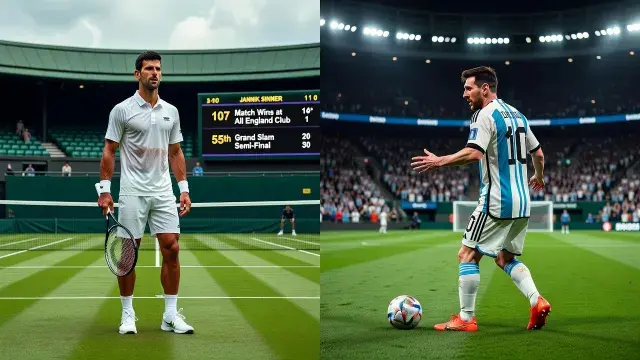
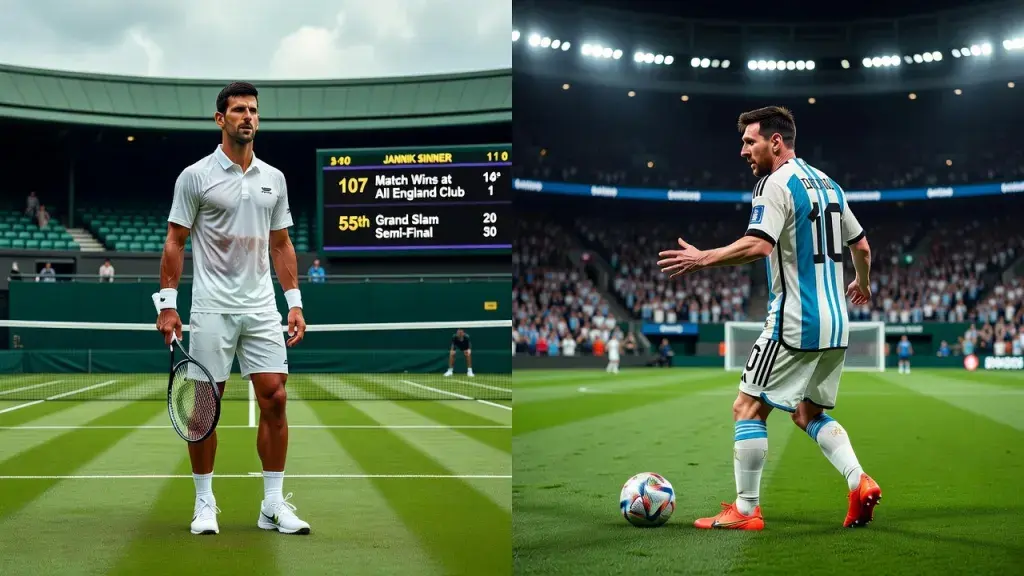
Novak Djokovic survived the longest quarter-final in Wimbledon history on Tuesday, grinding past Felix Auger-Aliassime over five hours and 15 minutes to reach his 55th Grand Slam semi-final. When he was told, courtside, that Lionel Messi had just been instrumental in Argentina's dramatic World Cup comeback against Egypt while he was battling it out on Centre Court, his response was characteristically dry. "It would be nice to play 90 minutes like him," Djokovic smiled. Two of the greatest sportsmen of their generation, operating simultaneously at the pinnacle of their crafts - and both 39 years old.
The parallel lives of Djokovic and Messi have long invited comparison, but what makes the summer of 2026 so striking is that the conversation has shifted from admiration to something closer to disbelief. Separated by just 33 days in age, both born in 1987, the two men debuted at the senior elite level in the same year - Messi for Barcelona in La Liga, Djokovic on the ATP Tour at the Croatian Open - and have never really let go since. The sporting world has spent the better part of the last four years waiting for the drop-off, the visible decline, the moment where age finally wins. It has not arrived. For context on how the broader sports market continues to evolve around elite performers and big-money moves, stories like tottenham target rashford newcastle tonali illustrate just how restlessly clubs chase the next headline act, even as the enduring giants continue to command the biggest stages themselves.
Djokovic has spoken openly about what drives him to keep pace with a generation of younger rivals. "I love watching greatness in the making and continuing the evolution of greatness, like Messi, like LeBron James," he said earlier at these Championships. "I feel like we are all setting the bar higher and moving the needle of what people thought is possible in terms of level of competition and level of performance at a late age." It is worth remembering that this exact sentiment was being expressed about both Messi and Djokovic in 2022, when Argentina lifted the World Cup in Qatar. And again at the end of 2023, when Djokovic won three Grand Slams in a calendar year. Three years on, they are still at it.
Records That Keep Rewriting Themselves
Numbers help frame what is happening at Wimbledon, even if they struggle to fully capture it. Djokovic's semi-final appearance against world number one Jannik Sinner will be his 55th at Grand Slam level - an all-time record he continues to extend with each passing fortnight. His tally of singles match wins at the All England Club now stands at 107, also an all-time record. He is the oldest player to reach a men's singles semi-final at a major since Ken Rosewall did it in 1974. These are not footnotes. They are the architecture of an era.
Djokovic is unambiguous about what is at stake. "Another great, historic run for me at the Grand Slams," he said after defeating Auger-Aliassime. "This is what counts the most, honestly. I still try to prove to myself and to others that I am able to compete with the best players in the world and beat them on the biggest stage." A win over Sinner and a subsequent final victory would deliver a 25th Grand Slam title - a number that, even now, feels improbable only in the sense that everything about Djokovic's longevity has felt improbable.
Messi's Moments, Carefully Chosen
On the same day Djokovic was locked in his Wimbledon marathon, Messi was doing what he has always done in tournament football - arriving precisely when Argentina needed him most. Against Egypt, he did not dominate from the first whistle. He managed himself, conserved, waited. And then, in the moments that mattered, he was there. That economy of effort, that intelligent reading of when to intervene, is not a concession to age. It is craft refined over two decades at the highest level. There was some uncertainty in the months leading into this World Cup about whether Messi's involvement would be as central as in previous tournaments. It should not have been in doubt. It never is.
The Class of '87 and the Question of Legacy
What Djokovic and Messi share goes beyond timing. They share the psychological architecture of champions who refuse to accept that the present is the limit. LeBron James and Tom Brady navigated similar territory in basketball and American football respectively - each redefining the ceiling for athleticism and performance beyond the age at which elite sport typically discards its participants. Djokovic and Messi belong in that company, and they know it.
"Messi was born the same year I was born, '87," Djokovic noted with a quiet satisfaction. "It was a good year to be born." He is right. It produced two athletes who have spent the better part of 22 years proving that the finish line is always further away than anyone assumes. Djokovic faces Sinner next. Messi and Argentina press on in their World Cup. In 1987, something quietly remarkable began. In 2026, it is still going.