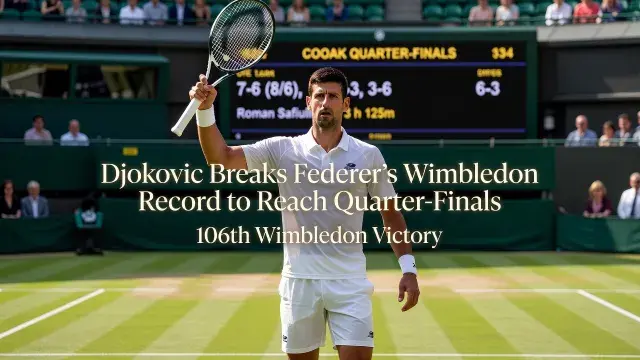
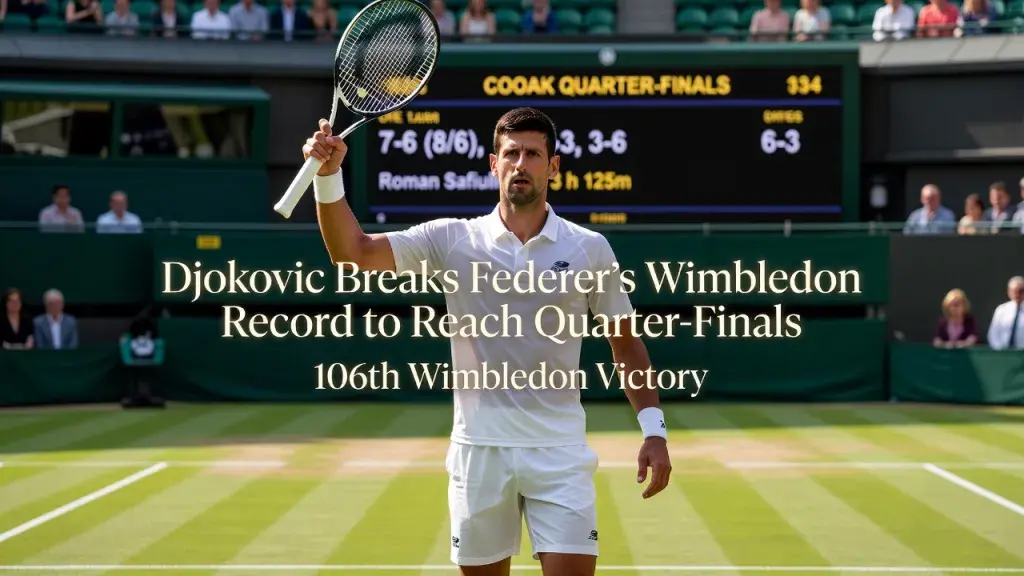
Novak Djokovic wrote another chapter in his remarkable Wimbledon story on Sunday, surpassing Roger Federer's all-time men's singles match-wins record at the All England Club with a hard-fought 7-6 (8/6), 6-3, 3-6, 6-3 victory over Russian qualifier Roman Safiullin in the fourth round. The win was Djokovic's 106th at the grass-court Grand Slam, moving him clear of Federer's mark and leaving only Martina Navratilova, who holds 120 singles wins at the venue, ahead of him across both the men's and women's draws. At 39 years old, the Serbian star is through to his 17th Wimbledon quarter-final and his ninth consecutive one - a statistic that defies almost every known principle of athletic ageing.
The victory, which took three hours and 25 minutes on a sweltering Centre Court, was far from smooth. Djokovic dropped a set, clashed with the crowd after smashing a ball in frustration, and at times appeared genuinely troubled by his vision, repeatedly rubbing at his eyes throughout a first set in which the world-ranked Safiullin - sitting at 132nd in the world - raced out to a 5-2 lead. That scoreline may have raised eyebrows in the broader sports world, where even fans more accustomed to tracking something like a lisa baum arsenal transfer would have done a double-take at a qualifier pushing the greatest grass-court player of his generation so close. Djokovic ultimately wrestled back the tie-break with a sharper, more disciplined approach, then used a six-minute break before the second set to reset and impose himself decisively.
The Serb's third set capitulation, accompanied by visible frustration and audible grumbling from the champion himself, drew a rare negative reaction from the Wimbledon crowd. "The outbursts as well, the meltdowns, I had a few of those today as well, I apologise," Djokovic said courtside. But he recovered his composure to close out the fourth set and seal the match. "Survive to thrive, that's how I feel. So hopefully the thriving part is coming," he added, with the kind of self-aware brevity that suggests a man who knows he has not yet hit his best tennis this fortnight.
A Record Built Over Two Decades of Dominance
Context matters here. Djokovic's 106-win record at a single Grand Slam venue represents a body of work accumulated over more than twenty years of elite competition. His 100 percent record in all 20 Wimbledon matches played against players outside the world's top 100 - and his perfect 34-0 mark against qualifiers across all Grand Slams - underlines that even when below his very best, Djokovic finds a way. He is also now the only man to have reached five Wimbledon quarter-finals from the age of 35 or older, a record that previously belonged to Federer. The symmetry of repeatedly eclipsing his great rival's name in the Wimbledon history books carries its own weight.
His next assignment at the All England Club will come in the quarter-finals against either Canadian third seed Felix Auger-Aliassime or Spanish 22nd seed Alejandro Davidovich Fokina. Beyond that, a potential semi-final meeting with defending champion Jannik Sinner looms as the tournament's most anticipated fixture, provided the Italian comes through his own last-16 assignment against Japanese qualifier Shintaro Mochizuki.
The Bigger Picture: Chasing History on Multiple Fronts
What makes Djokovic's Wimbledon campaign so compelling is the scale of what is still possible. A seventh title at the All England Club would draw him level with Federer on eight Wimbledon singles crowns. More significantly, a 25th Grand Slam title of any kind would break his current tie with Margaret Court and establish a new all-time record in the Open era, across both men's and women's tennis. It would also make him the oldest Grand Slam singles champion in the Open era. Those are not incremental milestones - they represent the kind of achievement that reframes an entire sport's history.
There are legitimate questions, however. Djokovic has dropped sets in three of his four matches at this year's Wimbledon. His movement has not always looked fluid, and his emotional stability has shown cracks when matches have turned against him. Safiullin, a player who arrived at the tournament in poor form, pushed him to the limit. Against Auger-Aliassime or Sinner, the margins will be considerably thinner. Djokovic knows it. "Our mind wanders all the time," he said. "It's very hard to keep it in the present moment - whoever does that is a winner." At 39, still competing at this level, still breaking records, he remains the most compelling figure in tennis.