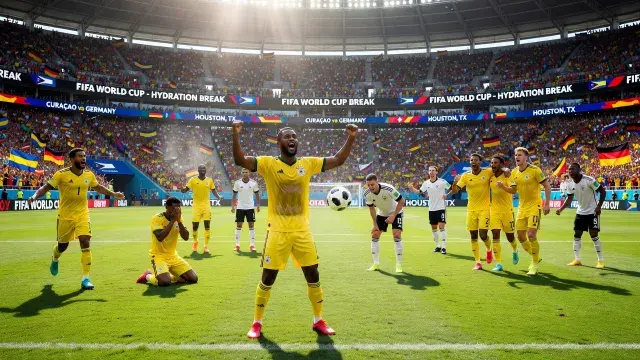
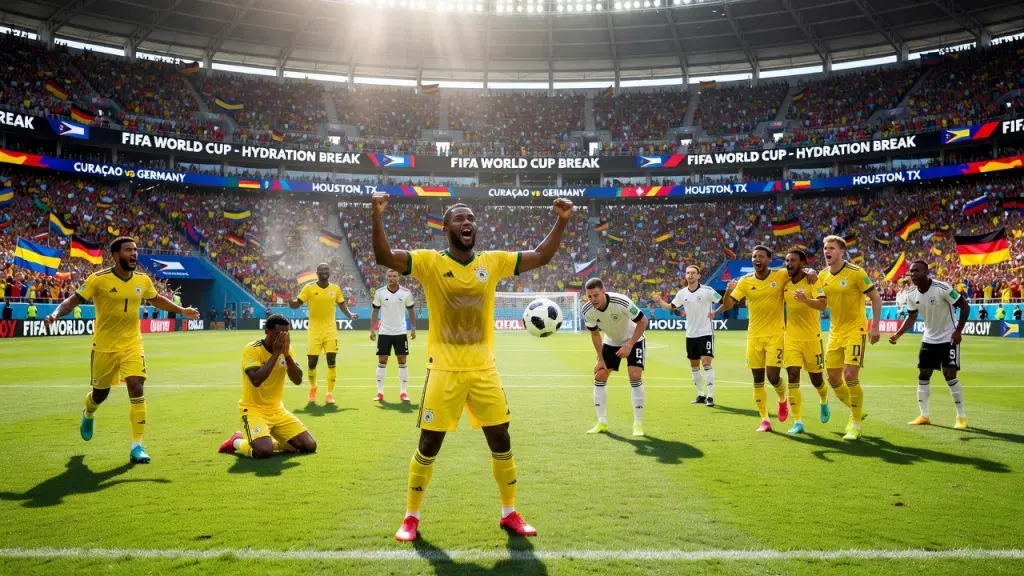
Curacao fans had every right to dream. When Livano Comenencia put the ball in the net against Germany, the smallest nation by population ever to qualify for a World Cup had levelled against four-time champions in Houston. The upset was live. Then, roughly 30 seconds later, the referee blew the whistle - not for a foul, not for an injury, but for a mandatory hydration break. Curacao never found that level again, conceding twice before halftime in what finished as a 7-1 defeat.
The incident has sharpened a debate that has been building since the tournament began. FIFA introduced compulsory hydration breaks at the midpoint of each half - 22 minutes in, with three minutes for players to rehydrate - as a welfare measure for athletes competing in summer heat across the United States, Canada and Mexico, where temperatures at the hottest venues are expected to exceed 90°F (32°C). The intention was straightforward: keep players safe. The consequences, however, have proved harder to control. Much like ante post betting on a long tournament, the variables that seemed manageable at the outset have a habit of compounding in unexpected ways as the competition progresses. ante post betting
"I actually felt sorry for them," former England striker Alan Shearer said on The Rest is Football podcast. "They scored and then it was maybe 30 seconds after that it stopped. So it's killed their momentum." Former Republic of Ireland captain Roy Keane was characteristically direct on The Overlap, the podcast he co-hosts with Gary Neville: "We're in America, right? So it's like it is a timeout. We love football because of the pace of the game... what it's doing is stopping the flow of the game, the momentum."
A Tactical Tool Hiding in Plain Sight
The breaks were sold to the public as a health measure. Coaches have treated them as something else entirely: a bonus tactical window that the sport has never previously offered at this level. Netherlands manager Ronald Koeman was unusually candid about it. "You can use the break to tell the players what they need to improve or what is good or what they should do better," he said. "So you can use it in different ways to your advantage, and this is what we will be doing."
The data from the early matches backs him up. In eight of the first 16 games played under the new format, goals were scored within 10 minutes of a hydration break resumption. Morocco had dominated Brazil in New Jersey and scored just before the first stoppage, only to find Vinicius Junior equalising less than 10 minutes after play resumed. Canada, the United States, Australia, Scotland, Sweden and Iran all registered goals in the same post-break window in their respective matches. Momentum maps tracking in-game pressure have illustrated the same pattern: something significant changes when the whistle blows at the 22-minute mark.
Curacao's Moment Frozen, Then Lost
For Curacao, the timing could hardly have been crueller. A nation of roughly 150,000 people had just scored against Germany. The noise inside the stadium, the belief coursing through a squad that had defied all reasonable expectation simply by qualifying, the psychological pressure building on one of world football's most decorated sides - all of it was interrupted before it could compound. When play restarted, Germany regrouped, found their footing and scored twice before the break. The 7-1 final scoreline buried what had briefly been a genuinely extraordinary sporting moment.
Shearer's sympathy was widely shared. Comenencia's goal deserved to breathe, to grow, to potentially tilt history. Instead it became a footnote, and the break that followed it became exhibit A for critics of the new policy.
Commerce, Conditions and Consistency
The sporting arguments against the breaks are substantive enough on their own. The commercial ones have added another layer of discomfort. In the United States, Fox Sports cuts to advertising during every hydration break. Spanish-language broadcaster Telemundo does not. For a sport that has historically resisted mid-half commercial interruption - unlike the NFL, NBA or MLB - the visual of a World Cup match pausing for adverts has jarred with global audiences accustomed to unbroken football.
Netherlands captain Virgil van Dijk, who watched World Cup matches on television before the Dutch opened their campaign with a 2-2 draw against Japan, was measured but clear. "Every time going to a commercial is a bit... not really that I like. I think for the neutral watchers on TV it's also not great." France coach Didier Deschamps took a more pragmatic view: "It's not two half times, it is four quarter times basically that we've got. This is what's been decided and so the players and the coaches adapt to this new reality."
The rule's blanket application has drawn specific criticism. FIFA mandated that breaks occur regardless of conditions, meaning Spain's match against Cape Verde in Atlanta - played indoors in an air-conditioned stadium - was still interrupted. The governing body said uniformity was necessary to "ensure equal conditions for all teams, in all matches." Spain coach Luis de la Fuente acknowledged the logic in extreme heat but questioned whether it was warranted everywhere. Norway's Staale Solbakken was less diplomatic: "I don't like it otherwise. I think it's unnecessary." Whether FIFA revisits the policy beyond this tournament remains open. The English FA has already indicated the breaks are unlikely to feature at the 2028 European Championship in the United Kingdom and Ireland - a cooler climate where the welfare justification would be far harder to sustain.