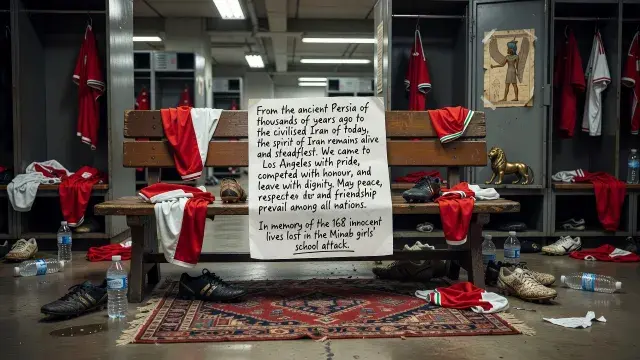
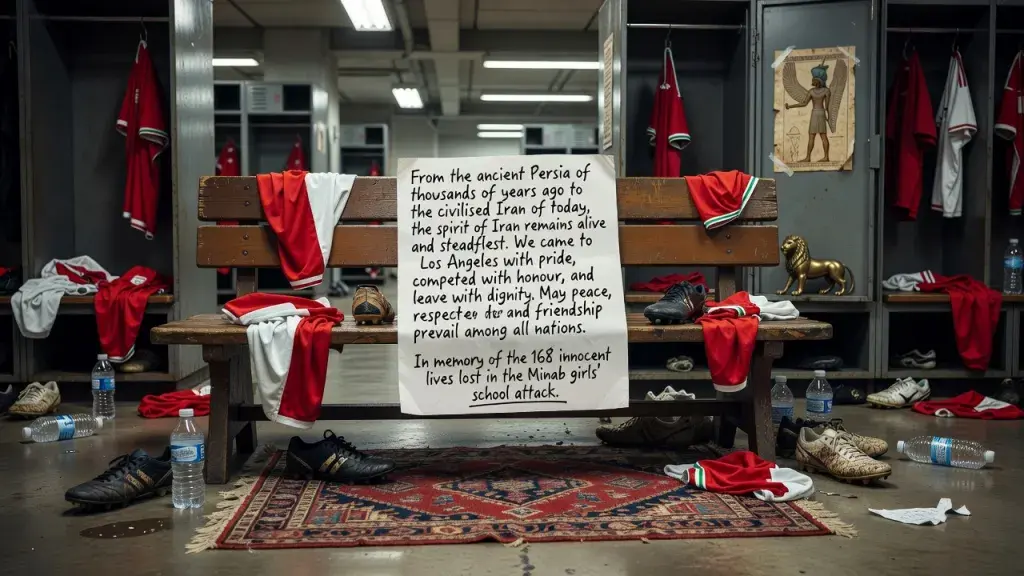
Iran's footballers departed Los Angeles Stadium with a point from their goalless draw against Belgium in Group G, but the most resonant moment from their time in the city came not on the pitch - it came in the words they left behind. The Football Federation of Iran (FFIRI) released a handwritten note left by the squad in their dressing room, a message that carried the weight of a nation competing under extraordinary political and personal pressure.
"From the ancient Persia of thousands of years ago to the civilised Iran of today, the spirit of Iran remains alive and steadfast," the note read. "We came to Los Angeles with pride, competed with honour, and leave with dignity. May peace, respect and friendship prevail among all nations." Iran are participating in the World Cup while their country and the United States - one of the tournament's three co-hosts alongside Canada and Mexico - are engaged in active negotiations to end an ongoing war. It is a backdrop that has given Iran's presence at this tournament a dimension that goes well beyond football; for context on how conflict and sport intersect in unexpected ways, even events as different as a bkfc bet carry cultural weight in their own distinct arenas of competition. The dressing room note also referenced an attack on a girls' school in Minab, where at least 168 people were killed on the first day of the war - a direct acknowledgement of the human cost of the conflict shadowing their campaign.
The FFIRI's decision to release the message publicly was a deliberate act. It frames Iran's participation not merely as a sporting endeavour but as a form of dignified national representation under duress. The phrase "thank you to every Iranian who gave their heart, voice and soul for Iran throughout these 180 minutes" speaks to an Iranian diaspora present in Los Angeles - one of the largest outside Iran itself - who turned out in significant numbers across both Group G matches played at the venue.
A Campaign Defined by Obstacles Before a Ball Was Kicked
Iran's path to these two Los Angeles fixtures was riddled with administrative and diplomatic friction. Multiple members of their backroom staff described as "integral" were denied US entry visas ahead of the tournament. Their full ticket allocation was revoked on the eve of the competition, prompting the FFIRI to call on FIFA to "uphold the principles of neutrality, fairness, and established regulations." The federation's public criticism of FIFA's handling of their situation added an institutional layer to what was already a deeply complicated political environment.
Rather than basing themselves in Arizona as originally planned, Iran relocated their World Cup camp to Tijuana, Mexico. Under the conditions of their visas, the squad is permitted to fly into the United States only one day before each match and must depart on the same day the game is played. Head coach Amir Ghalenoei did not hold back after Iran's opening 2-2 draw with New Zealand, describing his side as the "most oppressed" team at the tournament - a characterisation that, given the logistical constraints documented around their campaign, was difficult to dismiss as mere grievance.
Progression Still Possible as Egypt Fixture Awaits in Seattle
On the pitch, Iran's situation in Group G remains open. A draw in each of their first two matches - 2-2 against New Zealand and 0-0 against Belgium - leaves them with two points ahead of their final group game against Egypt in Seattle on 27 June. Whether that is enough to advance will depend on results elsewhere in the group, but the team has demonstrated competitive resilience despite everything working against a normal preparation.
There is one potential development worth noting on the travel restrictions front. Andrew Giuliani, executive director of the White House's World Cup taskforce, confirmed that "discussions are going on" regarding the timing arrangements for Iran's travel to and from their Seattle fixture. Whether those talks produce any easing of conditions before 27 June remains to be seen, but the acknowledgement from a senior US official that the issue is under active review represents at least a shift in tone from the rigid framework Iran have operated under so far.
Dignity as the Defining Theme
Whatever happens against Egypt, Iran have already ensured this World Cup participation is remembered for more than results. The dressing room note - handwritten, considered, and released by the federation - is the clearest expression yet of how the squad has chosen to carry itself through an unprecedented set of circumstances. It neither seeks sympathy nor ignores suffering. It simply states, with clarity, what the players want to stand for. In a tournament full of narratives, this one cuts through.